Showing posts with label Vanguard English. Show all posts

Tuesday, November 20, 2012

Deck Dissection: Hi-Beast Rumble

Hey guys, Homura here with a double dose today, since I was absent for quite some time already, and people were bugging me to come up with something new ASAP. Well, I went for a vacation, and fell sick after that, that's why you guys were unable to see new posts coming up in the blog. But now, I shall resume my writings with another post dedicated to the VGE community in conjunction with the upcoming release of the new set, BT-04 'Eclipse of Illusionary Shadows'.

If I recall correctly, I've already posted up a Shadow Paladin article sometime back, so I won't be talking much about them except for certain playable cards sometime in the future. Instead, I'll be talking about their 'good' counterparts, the Royal Paladins today. In BT-04, the Royals will gain some new support, basically a totally new archetype that is quite fun to play with while it lasts. Remember when High Dog Breeder Akane was released as one of the first cards that work together with a specific 'race' instead of clan? Yes, the deck that I'll be mentioning will be centered around the Royal Paladins' most trustworthy and loyal allies, the Hi-Beasts. And let's have a look at the deck of my choice:

Grade 0
Bleugal x1 (FV)
Alabaster Owl x4 (Critical)
Bringer of Good Luck, Epona x3 (Critical)
Margal x4 (Draw)
Arms Dealer, Govannon x1 (Draw)
Yggdrasil Maiden, Elaine x4 (Heal)

Grade 1
Little Sage, Marron x4
Flash Shield, Isolde x4
Pongal x3
Snowgal x4

Grade 2
Beast Knight, Garmore x3
Knight of Silence, Gallatin x3
High Dog Breeder, Akane x3
Blaster Blade x2

Grade 3
Fang of Light, Garmore x3
Swordsman of Exploding Flames, Palamedes x3
Soul Saviour Dragon x2

As you see, this deck is lacking the presence of some Royal Paladin staples nowadays like KoK Alfred and the Galahad chain. Instead, this deck focuses its swarming abilities through Hi-Beasts, which can also in return power up their allies. Let's have a look at the choices of the deck I've posted:

Grade 0
Bleugal is the starter for this deck. Since Barcgal was banned, most people shifted to the Galahad series as their starting plays as they generates a free ride (+/- 0 from hand). But now, Bleugal returns as a starter that can be pulled back upon riding, thus also generates a +1 board presence during G1. Bleugal's power up ability can be ignored unless you are playing multiple copies of it, which I don't think it's a good choice. You can still switch back to the Galahad chain, you just need to adjust the deck composition a bit, then you're good to go.


The trigger lineup here is as usual, 7-5-4. With the capability of hitting high numbers, this beatdown deck really craves for Critical Triggers to end the game as soon as possible, as this deck in my opinion, is lacking the endurance to play a drag game.

Grade 1
The stars of the G1 lineup are none other than the Hi-Beasts, Pongal and Snowgal. Pongal is a good tutor for Soul Saviour in case you need her for your Final Turn, or in case you're gradestuck, plus it can be tutored out via Akane as well. Also, its 7k power makes it a very good booster to hit 11k Vanguards in the current environment.


Snowgal is the main booster for this deck. Starting as a 6k unit, it doesn't seem attractive at the beginning. But, once you have multiples of Snowgal on your field, they get +1000 power for each other one present, making them a maximum 9k power beatstick/booster once you have all 4 in play. However, having 3 is already considered good enough as they can be considered as your extra Marrons, plus they can be tutored out as well. Just beware of Kageros. I guess I don't need to further explain why Isolde and Marron are inside.

Grade 2


The G2 lineup for this deck focuses slightly heavier in the tutoring part, with as much as 6 tutors in the deck to search out the Hi-Beasts. Akane here is the universal tutor, whereby she can search out any Hi-Beast in the deck, whether its Pongal to further tutor for SSD, or Snowgal to increase their numbers.


Beast Knight, Garmore is the new entree in the deck. With a base power of 8k, he might not look that impressive on its own, but what makes him good is his tutoring skill. Upon appearing in play, you can discard a hand card to tutor out a Snowgal from your deck. And if you already have several Snowgals in play or some other boosters, Garmore himself can whack for up to 16k worth of power, which is considered decent in the current environment.


Blaster Blade is in the deck to take care of those pesky S-Intercepts, annoying Grade 2s, and some threatening G3, because in the current environment, only Blaster Blade can easily take care of G3s without sacrificing one attack. Gallatin is there to provide some extra punch, feel free to replace him with Knight of Determination, Lamorak if you prefer his design more, lol.

Grade 3
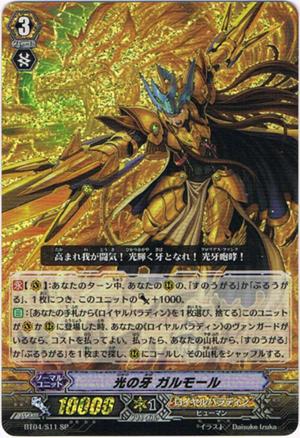

Here we go, into the Grade 3s. The main star here is Fang of Light, Garmore. This earlier counterpart of the Gold Paladin Garmore is the main Vanguard of this deck. Upon appearing in the VG circle, his skill, which is similar to Beast Knight's triggers, allowing to tutor out either a Bleugal or Snowgal from your deck and call it out. Plus, FoL gains +1000 power for each of those two units in play, enabling him to hit very high numbers, for example 21k when you have 3 Snowgals in play and boosted by one of them.


Our secondary beater here is Palamedes. Nuff said, Palamedes is one of the best G3 ever printed for RP, with the capability to handle even Crossrides on his own, he in automatically included in the deck without any question. A unit that can hit 21k easily? Why not!


As for Soul Saviour Dragon, as usual, she is the finisher of the deck. When you think its time, just Soulblast 5 and watch your opponent's hand cards fly away, or cards in their deck fly away into the damage zone. Definitely a solid finisher for any Royal Paladin decks.

Hence, this is my version of the FoL deck. Truthfully speaking, other variants of the deck can't really stray much from this 'skeleton', whereby the core of the deck like Snowgal, Garmores, Isoldes, and co. are no-brainer inclusions in the deck. The deck is quite fun though, so far the only bad matchup I see from my JP experience is Goku Kagero, whereby you must make sure the timing of your Snowgals must be correct in order to minimize casualties. So give this deck a try, and let me know how it feels.

Tuesday, September 4, 2012

After the Storm: Cardfight!! Vanguard EN Post-WCQ Analysis

Hey guys, Homura is back after quite a few days of absence due to work and health problems. WCQs for Europe and Canada have already kicked off last week, and we can see from the statistics that Gold Paladins are dominating the metagame. Actually, I would say that this scenario was actually a carbon copy of the previous Japanese WCQs and Championship Finals. During that time, Royal Paladins was so famous and widely used that they almost have Top 8 appearances in every single tournament, and also one-two finishes during the Finals.

But why we don't see other clans topping? What was the reason of their absence? In my opinion, the reason why the traditional clans don't have any high place finishes was due to the fact that they lack a very crucial thing - Limit Break. Well, isn't Kagero and Royal Paladins got their LB unit already? How come they still can't top? Which brings me to my second point - Support.

As we can see, Gold Paladins got tons of support during the first 3 months of their debut in English, together with 2 possible deck types which was equally strong (not to forget featuring Limit Breakers also). What about Kagero and Royal Paladins? Compared with Gold Paladins, these two supposed-to-be the main clans of the game kind of fell short in terms of support given to them.

Let's look at Kagero. At the moment, the only deck that was actually viable for Kagero players was the Goku-Blade build. I know that Lawkeeper exists, but comapring both of them, I would say Goku-Blade fares better against the majority. And moving onward to Royal Paladin. RP is worse, with only one possible competitive deck ready at their disposal - Barome-Saviour. Truthfully speaking, Pendragon was a flop, it never seen play in JP tourneys, and I doubt it'll be seeing major play in EN tourneys.

So all and all, I think that GP will still be the deck to beat in this WCQ season. One weakness of the EN environment was that the sets were not parallel, meaning that they will not have what we JP players already had. If you all did your research, you should be able to see that regardless how strong GP was, Kagero and RP still dominates the metagame, as we have access to Majesty Lord Blaster and Dragonic Overlord The End.

This article was not written to show off the privileges that we JP players have, but to show you what defines a metagame as a whole. As what we can see from the statistics, sheer numbers can actually define a metagame. Imagine if 80% of the people were using Kagero and we'll be able to see Kagero topping everything. It's just as simple as that.

Friday, August 24, 2012

Calm Before the Storm: Lookout! (Pt.2)

Hello guys, Homura here with the 2nd part of 'Lookout!', which covers the few clans that you'll see running rampant in most tournaments, and how to lookout against them. As promised in my earlier article, I'll be covering Narukami, Great Nature and Gold Paladins today.

As I said earlier, the decks that you'll definitely see the most are Royal Paladins, Oracle Think Tanks, and Kageros. However, with the ascension of Limit Breakers, more clans are joining in the fray, especially Gold Paladins and Narukami, the second clans of the main characters. Without further ado, let's have a look in these clans and see how can we lookout! while playing against them.

Gold Paladins
Gold Paladins, up to the WCQ period, has 2 different builds that we can play - Blonde Ezel, and Spectral Duke Dragon. Each of these builds are distinct in playstyle, but still sticks to the root of the Paladin clans, which is swarming the board and gaining massive board advantage.


First up, I'll be talking about the Blonde Ezel build. Blonde Ezel is a 10k-power Limit Breaker that allows you to Superior Call the unit from the top of your deck and gaining a power boost equal to the original power of the Superior Called unit. Ezel works almost the same as King of Knights, Alfred of the Royal Paladin clan, albeit in a different way. Ezel's skill nonetheless gives you a free unit and a free power boost, but the point here is the unit called is random.


What do I mean by random? Yes, you might call out a precious Trigger unit. The reason why Royal Paladins are far more superior than their Gold counterpart is because they have targeted calling, meaning that they can call whatever they want and whatever they need to fit the situation in hand. The only unit in GP that can do that is Great Silver Wolf, Garmore. Without BT-07 to boost up Garmore's efficiency, the best that he can do is just to maybe call out Nemea Lion or Beaumains to maintain your attack force. But nonetheless, GP is still very strong thanks to them still having Superior Calling skills and power boosts as a bonus.


The other build viable for GP will be the Spectral Duke Dragon build. This build also plays heavily on Superior Calling, but mostly is to fuel SDD's Limit Break. SDD has a very devastating Limit Break, which allows is to 'cheat away' Null Guards. So you really have to think properly before deciding on how to defend SDD's attack.

SDD comes in a Chain Ride package, where every successful chain will allow you to spawn two more units from your top deck at the cost of retiring one on the field. Skill-wise, SDD is better than Ezel because it allows you to setup your field earlier, and allow even more Superior Call chains as long as you hit the units that activates their skills once they are called from the deck. The only downside of SDD is it is highly dependent on the chain to unleash its full potential, so decks like Kagero and Narukami will be tough against them, especially if they're able to stop your chain early game.


With the release of BT-07, GP players might think of a way to tech in the White Hare division cards, as they provide a plethora of skills that activate when you call them from deck, perfect for SDD builds. Also, they can also tech in Pelinore as a finisher, with his fairly low-costed Limit Break. So be prepared to face a lot of GPs during the WCQs.

Narukami


On the other hand, Kai's 2nd clan doesn't share much success compared to the Gold Paladins. So far, they only have one viable deck that is tournament-worthy, which is Dragonic Kaiser Vermilion. Narukami plays very differently from Kagero, as they don't have much retiring power. But in return, they gained ways to disrupt your opponent's defenses by preventing them from Intercepting through the Desert Gunners, and Vermilion's Limit Break.


Also, another one of Narukami's advantages will be their capability to churn out high power attacks at ease, even without the aid of Limit Break. The lineup of Breakthrough Dragon, Djinn of the Lightning Flash boosted by Red River Dragoons are already very fearsome in this environment full of 10ks. Topping it up with the existence of Photon Bomber Wyvern, Narukami defines the next level of raw power and the continuous pounding of the Vanguard.

The only weakness of Narukami besides only having one type of viable deck will be the setup of their field. As long as you can keep those Red River Dragoons at bay, you're quite safe from those 20k attacks, somehow. Even so, be prepared to see a lot of Narukamis in WCQ though.

Great Nature 
The newcomer from BT-07, Great Nature is a force not to be taken lightly. Despite being a new clan, GN already displayed their strong presence by having multiple deck types which can pose a serious threat to all clans out there, if played properly.


First up will be School Hunter, Leopald. Leopald focuses on the recurrence of units while providing ample support for 'brainjacking' (those that read my GN article should know this term by now). Comboing with Monoculars and Binoculars Tigers, you can continuously brainjack your units to make them into monsters, while recurring them when they're about to be retired via Leopald's LB. The only downside for Leopald's build is that Leopald is only a 10k Vanguard, rendering it extremely vulnerable for 20k lines (which can be done easily).


Next in line will be a deck with the Lox Ride Chain as the main Vanguard. Also utilizing the brainjacking specialty of GN, Lox gives a additional advantage by giving units the skill to replace themselves when they are retired via a free card draw, of course the condition is to have the chain ride successfully done. In addition, Lox comes with a Persona Blast, being able to give a unit +4k power and +1 Critical. Not forgetting to mention that Lox is also a 11k unit when you have the G2 Lox in your Soul. The most crucial weakness of this build, like other chain rides is the chain itself. You screw the chain, you screw yourself.

Another point to take note when playing against GN decks is be cautious on brainjacking units. When one comes down, kill it. Without brainjacking, GN is less dangerous.

And here you go, the 2nd part of the "Lookout!" series. Chances I might do the 3rd part of this series, just let me know which clan you think will be 'spammed' in WCQs and I'll try to do a writeup about them. Until then, bye guys!

Friday, August 17, 2012

Calm Before the Storm: Lookout! (Pt.1)

Hello everybody, this is Homura here, bringing you an analysis for the upcoming World Championship Qualifiers. In this article, we'll be discussing the decks that will most probably being fielded by most players, and how would they fare in the current environment.

As we all know, the WCQ for Vanguard English is starting in September 2012, which means in another 2 weeks, we'll start fighting hard for a spot in the Regionals. However, by participating in such a big tournament, we all should know about the environment more or less, what decks are going to be played, and how to play around those decks. Hence, in today's article, I'll mostly discuss about the metagame decks at the moment, and provide a bit of insight on how they work, so you guys can have a bit of knowledge on these deck so that you can fight better against them.

Kagero
Let's start with Kagero. At the moment, Kagero bears the title of having one of the most dangerous deck in the current environment - Goku-Blade. That aside, other Kagero deck types including Dragonic Lawkeeper and Blazing Flare Dragon are also contenders of the metagame deck spots alongside Goku. But in my opinion, most Kagero players will either play Goku or Lawkeeper as they gives the most stability among all the other Kagero decks out there.


Firstly, Goku-Blade provides Kagero players with a big dosage of what they're supposed to do - Retiring Units. Goku makes all your G3s into 'Bomb Triggers', enabling you to retire a G1 or lower Rear Guard whenever a G3 shows up during your Drive Check. Your opponent can't actually stop you from triggering a G3, so the only thing that they can do is either helplessly watch their precious boosters got retired, or stop playing anymore boosters to preserve hand size.


Either way, this is very advantageous for you as the less boosted attacks they launch, the easier for you to guard. What about the extra G3s you have triggered? No problem, you can either use them as attackers, feed them to your Barris, or either ditch them away with Aermo or Dragon Monk Gojo to replace them with something that has a shield value. All and all, Goku-Blade is one of the decks to beat.


Secondly, Dragonic Lawkeeper might be another choice if you decide not to bring Goku for some reason. Lawkeeper is actually a more straightforward beatdown deck, utilizing Lawkeeper's Limit Break to control your opponent's Rear Guards' numbers in order for you to create 20k++ power lines together with Dual Axe Archdragon. Retiring here has to be used sparingly as Lawkeeper hungers for CB a lot whenever you want to use the LB. Without Bellycosity Dragon available to help you keep the CB open, timing becomes a very important factor here. Make sure each time you perform a LB, it better make an impact towards your opponent.

Royal Paladin
The sad part about the current RP arsenal is there's only 1 possible deck to bring into the tournament scene. But the good news is that particular deck is also the best deck available for them as well! The deck that I'm mentioning about is none other than Barome-Saviour.


Barome-Saviour is also another beatdown deck that requires you to slightly swarm the field a bit more to unlock all your unit's full potential. Barome-Saviour can easily make all three columns into 20k++ ones to constantly force your opponent to discard a lot of cards just to guard your attacks. With Baromedes running around like nobody's business, your Vanguard should be slightly safer as most people will aim to get rid of your Baromedes first.


To put some more icing on the cake, RP has unparalleled tutoring abilities compares with other clans. Basically, what you need, they can just search for it. With Pongal, King of Knights, Alfred, as well as High-Dog Breeder, Akane at your disposal, you can definitely search for any missing part of your perfect setup.

Oracle Think Tank
OTT has dropped in favor in the JP environment thanks to it lacking any sort of Limit Breaker or Persona Blaster, but has recently topped a few tourneys thanks to the arrival of supports for Coco builds. However, in the EN metagame, Tsukuyomi has just made her debut, and the deck is bound to have a lot of appearances in the tournament scene.


With the legal 'stacking' of triggers via Tsukuyomi's ride chain skills, you can basically determine the flow of the game during mid-late game if your memory is good. Besides, the drawing power of Tsukuyomi-Amaterasu decks are also very strong, enabling the player to have ample defense during their opponent's turn. The only downside of this deck is their lack of resilience against early-mid game rush decks like Spike Brothers or Nova Grapplers.


The other choice that we'll most likely see in WCQ will be the Coco build. With BT-07 accessible for EN players, OTT players will have alternatives on whether they want to play the Soul build or the Soulless build. Compared to the former, Coco is more geared towards beatdown, with quite a lot of support cards that can do the most potential while you're Soulless. Depending on your preference, actually both decks are also quite viable for tournament play. For me, I would prefer Tsukuyomi-Amaterasu thanks to Tsukuyomi's 11k power and the Trigger anticipating elements of both the G3s.

Okay, so far we've covered 3 clans which I personally think will appear quite frequent in tournaments. In the next installement, I'll be covering Gold Paladins, Great Nature and Narukami. Until then, see you later!

Wednesday, July 25, 2012

The Parallel Vision: Moon and Sun for VGE

Hey there, it's me again for another edition of 'The Parallel Vision'. In today's edition, I'll be talking about one of the format's defining deck, and the deck that most players of the English environment is anticipating for - Moon and Sun.

What is 'Moon and Sun'? This deck is actually an Oracle Think Tank deck that has become the most dominant deck for the Japanese format before the advent of Persona Blasters. And thanks to the release of BT-03 for the EN community, you guys can finally experience one of the most interesting and skill-based decks of all times. Guys, meet the star of the deck:


Before I put up a decklist, let me describe how this deck is played. Basically, this deck is your CEO Amaterasu deck of BT-01, but with a lot of upgrades. With the Tsukuyomi series accessible for us, not only OTT's drawing power is improved, but their overall offensive and defensive capabilities as well thanks to Full Moon's 11k power. Now, let's have a look at the list:

Grade 0
Godhawk, Ichibyoshi x1 (FV)
Psychic Bird x4 (Critical)
Oracle Guardian Nike x2 (Critical)
Miracle Kid x3 (Draw)
Dream Eater x3 (Draw)
Lozenge Magus x4 (Heal)

Grade 1
Goddess of the Crescent Moon, Tsukuyomi x4
Oracle Guardian Gemini x4
Battle Sister, Chocolat x4
Battle Sister, Vanilla x2

Grade 2
Goddess of the Half Moon, Tsukuyomi x4
Oracle Guardian Red-Eye x3
Silent Tom x2
Oracle Guardian Wiseman x3

Grade 3
Goddess of the Full Moon, Tsukuyomi x4
CEO Amaterasu x3

You see, there's actually not much changes from the older builds, just that now, you've got better options. Your deck starts performing when you hit the 6th Soul, which will unlock several skills of your units. Now let's take a tour of how this deck works.

Grade 0


Without a doubt, Ichibyoshi is the starter for this deck. Ichibyoshi does not have the Superior Call skill like most other starters, but it allows you to check the top five cards of your deck, and if you found a Crescent Moon among the five, you can Superior Ride it, and skip your Normal Ride Phase. This skill not only allows you to gain a free Ride, but also can potentially remove up to five non-triggers from your deck, thus increasing the odds of your triggers to hit during checks.


Although Tsukuyomi increases the draw power of your deck, you still need sufficient draw to maintain your hand sizes, hence the 6 Critical, 6 Draw trigger lineup. Psychic Bird is a good card to help you bump your Soul to 6, plus it nets you a card.

Grade 1


At G1 we have Crescent Moon Tsukuyomi. She's a 7k unit, and shares the same skill as Ichibyoshi (to search for Half Moon of course). 4x of Gemini is standard, and 4x of null guard is viable for OTT because you'll most likely have extra cards to spare for the null's cost.


Battle Sister, Vanilla is an interesting choice. At normal times, she's a 6k unit. But when your Soul hits 6, she becomes a 10k Shield thanks to her skill. Very good for that time when you're 5k-10k shield short to guard.

Grade 2
Another successful ride will bring your Crescent Moon into her G2 form, Goddess of the Half Moon, Tsukuyomi. Half Moon is a 9k unit, which is a decent number (able to hit any VG with a boost, and sometimes soloing RGs). She also shares the same skill as her G1 form, where upon success, you can complete the chain by riding into Full Moon Tsukuyomi.


Her second skill is the key skill. Upon appearing in the VG circle, if your Soul has both Ichibyoshi and Crescent Moon, you may Soulcharge 2. By doing so, it instantly bumps your Soul count to 5, just one short from unlocking your units' skills. But bear in mind, if the chain ride fails at any point, the Soulcharge doesn't happen.


Another new unit that we'll add in the deck is Oracle Guardian Red-Eye. Red-Eye is a clone of Blue Dust from the Dark Irregulars clan. Upon a successful attack, you may SC1 if your VG is an OTT unit (duh!). It is also good to bump in the 6th Soul and its stats also makes it a good Rear Guard.

Silent Toms and Wisemans are there to fill up the aggro role with their power and skills. If you intend to play more defensively, you can include in Security Guardian (Special Interceptor) for the extra defense.

Grade 3
At the pinnacle of the Ride Chain is the Goddess of the Full Moon, Tsukuyomi. Full Moon is the first OTT unit with a printed 11k power. However, the downside is, if you don't have Ichibyoshi, Crescent Moon, and Half Moon in your soul, she's only a 9k.


Barring her penalty aside, she has a very good skill to back her up. Upon having 6 Soul, you may activate her skill by paying CB2. If you paid the cost, you can draw 2 cards from your deck, and then Soulcharge one card from your hand. This is good filtering tactic for you to dish out useless cards like Draw Triggers or redundant G3s.


To play around with Full Moon's power deduction penalty, we have Amaterasu to back her up. As a VG, Amaterasu can SC every turn and allows you to check the top card of your deck. If you're lucky, you may be able to charge in the missing Tsukuyomi components, and reride into Full Moon for her maximum benefit. Otherwise, you can still dictate triggers with Amaterasu's skill. Her +4k power boost when you have 4 or more cards in your hand is also good enough to punch through any VG in the game with a boost.

So what do you think? In the JP format, this is OTTs best deck ever before new cards for Coco are introduced. As for the EN environment, I think this deck will definitely make an impact in the metagame. There's actually a trick to play this deck, but that trick is for me to know, and for you to find out ^_^

Have fun with this deck guys, and this is Homura signing off!

Monday, July 16, 2012

The Parallel Vision: Pale Moon Circus

Hey guys. Today I'll be bringing with me a post that most EN players are longing for - Pale Moon. One thing that I need to say before I progress, frankly speaking I'm never a Pale Moon player, so if you think you have a better idea that mine, go ahead and try it. For this post, I'll try my best to provide what I can understand from my experience in trying Pale Moon and playing against them.

BT-03 for EN is coming soon within a month's time, and as expected, the hype generated is so high that everybody is anticipating to play the new clans featured inside, especially Pale Moon. Pale Moon is a clan that focuses on the Soul, just like its fellow Dark Zone clan, Dark Irregulars. However, unlike DI, Pale Moon focuses more on the 'Quality' of your Soul, instead of the 'Quantity'.

The specialty of Pale Moon is their 'tagging' ability from Soul. With a few units available for them that possess this ability, Pale Moon can generate a flurry of attacks just like Spike Brothers, but the advantage of Pale Moon's tagging is they won't lose presence. Let's have a look at a Pale Moon sample decklist upon the release of BT-03:

Grade 0
Underworld Manager x1 (FV)
Dynamite Juggler x4 (Critical)
Candy Pierrot x4 (Heal)
Rainbow Magician x4 (Draw)
Spiral Master x4 (Draw)

Grade 1
Turquoise Beast Tamer x3
Underworld Hypnotist x4
Midnight Bunny x4
Skull Juggler x3

Grade 2
Crimson Beast Tamer x4
Barking Cerberus x4
Mirror Demon x3

Grade 3
Nightmare Doll Alice x3
Dusk Illusionist, Robert x3
Barking Manticore x2

With only the basic cards available for Pale Moon, the deck focuses more on either Robert's Megablast, or Manticore's beatdown strategy with only enough tagging units to not clog the deck space further.

Grade 0


The only starter viable for PM, Underworld Manager is a unit that doesn't Superior Call itself after you ride a G1 Pale Moon. Instead, he gives you one Soul upon riding. The trigger lineup focuses more on Draws, with a total of eight Draw Triggers available. Nothing else interesting for the G0 lineup.

Grade 1
The interesting side here for the G1 lineup is the exclusion of the 8k vanilla, Dark Metal Bicorn. Because Pale Moon is full of utility units that is quite important for the deck, there's really no slot to put in the Bicorn. Since we have abundance of drawing power, the null guard is at maximum. Skull Juggler is to provide Soul upon coming into play so that you can fill up more units (hopefully the ones that can tag).


Midnight Bunny is the core G1 of the deck because of her tagging skill. Being a 7k power booster, she's still good on the field even if you don't get to tag her in or out.


The secondary G1 unit is none other than Turquoise Beast Tamer. As long as you have Crimson Beast Tamer in your Soul, she's a formidable 9k booster, being able to bring your units to more than 16k total power when attacking.

Grade 2


The unit that plays the most important part in the deck at Grade 2 is Turquoise's sister, Crimson Beast Tamer. As long as she's in your Soul, all your other Crimson Beast Tamers will also get a +3k during your turn. And when you pair her together with her sister, it's a 20k line during your turn.


Mirror Demon is the G2 version of Midnight Bunny. His advantage besides his tagging ability is he can attack, as well as Intercept. Personally I would not play more than 3 of him, since there are too many 8k units in the deck and I don't want to provide too many easy targets for my opponent.

Grade 3


The Grade 3 lineup for Pale Moon allows us to have a few varieties in our decks. Barking Manticore is our beatdown option. Upon appearing as a Vanguard, you may draw a card, and Soulcharge a card from your hand. This is a good skill, where you can SC your Crimson Beast Tamer if you can't do it previously. Manticore also gets a +3k attacking bonus while Crimson is in your Soul.


Dusk Illusionist, Robert is the control side of the deck. With the same Soulcharging skill as CEO Amaterasu, you can literally manipulate your triggers. He also comes with a devastating Megablast, which can instantly break your opponent's back row by putting all their G1 or below units into their Soul. Though the Megablast is quite hard to achieve, the Soulcharging skill is enough to win you games.


The G3 tagger, Nightmare Doll, Alice is our utility G3. Personally I wouldn't mind riding Alice first, because you can just reride after that and Alice will be in your Soul. Alice is the main threat here. By having multiple Alices on field, especially when boosted by Midnight Bunnies, your opponent will definitely waste their hand to guard because once the attack goes through, 2 units will instantly come out, creating a new attacking line.

So here you go, Pale Moon in BT-03 for the EN environment. For now, I would say Pale Moon is like a rookie circus, whereby only the basics are included. But this provides a good platform to learn the specialties of Pale Moon without taxing your brain too much. Once BT-07 for EN hits in, that's when the real show starts. So until then, have fun being the Troupe Master for Pale Moon!

Thursday, July 12, 2012

The Parallel Vision: Jurassic Park for VGE

Hey guys, Homura here, back with another dose specially made for VGE players. From what you can read from the title, today I'll be talking about Tachikaze in the English environment.

BT-03 is just around the corner, and it brings us Tachikaze together with the other clans. After 3 sets, finally the Dino Dragons can unleash their fury in the fullest. Basically, Tachikaze is a very simple clan to play, where by you're just going to hit your opponent with big power counts, and nothing much. Subtlety is not what a 'primitive' clan will have an idea of, so they just prefer to trample you, knock you down, and munch on you.

I'm still not sure whether the EN release of BT-03 will give Tachikaze their Promo card or not, so I'll assume that they don't. And with this, let,s have a look at a Tachikaze sample decklist for the EN version:

Grade 0
Dragon Egg x1 (FV)
Black Cannon Tiger x4 (Critical)
Pack Dragon, Tinyrex x4 (Stand)
Herbivore Dragon, Brutesaurus x4 (Draw)
Savage Shaman x4 (Heal)
Ironclad Dragon, Shieldon x2

Grade 1
Sonic Noa x4
Archbird x3
Winged Dragon, Skyptera x4
Savage Warrior x2

Grade 2
Cannon Fire Dragon, Cannogear x4
Ravenous Dragon, Megarex x4
Assault Dragon, Blightops x3

Grade 3
Tyrant, Deathrex x4
Chaos Dragon, Dinochaos x2
Ravenous Dragon, Gigarex x1

The aim of the deck is simple: Call your big guys, and whack with big damage. No further explanation needed. Off we go for the deck composition analysis.

Grade 0


Dragon Egg is our only viable starter here. With an ability to Superior Call itself after being ridden, plus being able to CB1 to return itself to your hand when it is retired from RG suits the theme of Tachikaze a lot, by being able to constantly provide fodder to feed your bigger Dino Dragons. The trigger setup is however, sad for me, because I was hoping Tachikaze can get multiple of the same triggers. Unless the inclusion of the Japanese PR Draw Trigger, Bombarding Dragon, Sledge Ankylo is confirmed in BT-03 for EN, we have to settle with a balanced 4-4-4-4 Trigger setup.


The interesting part here is the inclusion of 2x Shieldon. Why would you add in extra G0s? This is because most of our G2 doesn't do anything when they are retired, so the Shieldons are inside to transform Blightops from a 5k shield unit into a 10k shield card in your hand. You'll never know when the extra 10k worth of guard can save you from a certain defeat.

Grade 1


4x Sonic Noa and 3x Archbird is a standard already, so I don't need to explain much. Winged Dragon, Skyptera is at maximum because its one of the crucial cards in the deck. Skyptera shares the same skill as Dragon Egg, where you can CB1 to return it to your hand when it is retired. Not only it generates hand advantage, it is also a decent booster for your units.

Savage Warrior fills in the remaining slots because he can gain a +1k power boost whenever your RG is retired on your turn. So once you're able to trigger the 'cannibalizing' skill of your other units, you can pump Savage Warrior's power to a considerable amount. But I would not suggest more than 2 of him, as he's only a 6k vanilla if you can't trigger your cannibalizing skills.

Grade 2


Cannon Fire Dragon, Cannongear is our mainstay unit at G2. Basically it's like Genocide Jack, which it has a drawback for being a 11k G2. The drawback is if it is called out to VG circle or RG circle, you need to retire one of your Rear Guards. This drawback however, is easily mitigated when you have Skyptera or Dragon Egg on field, and you have 1 damage. Also, it shares Jack's skill whereby he get's an extra power boost when you're boosting it with a Tachikaze.


Blightops is also a very interesting unit. The presence of this unit will make your opponent for most of the time, only focus on your Vanguard, because they don't want to give you a free 10 shield through Blightops' skill. It's a good thing for you, because you want to take some damage to pay for your CBs, and as long as your opponent doesn't attack Blightops, you'll always have a 9k beater on your side of the field. Megarex as 4x is standard.

Grade 3


The star of the deck is Tyrant, Deathrex. He's one of the Vanguards in the game that can automatically gain a power boost of 5k just by declaring an attack. So without boosters, he can solo almost anything in the game except 11ks and 13ks. By putting Skyptera or Sonic Noa behind him, he can hit 21k and 23k just like that. The downside of this plus is whenever its attack hits, you need to cannibalize somebody, which can also be easily done by offering the booster behind it (the best booster in this situation is always Skyptera, where you can CB1 and return it back to your hand).


Chaos Dragon, Dinochaos is here to provide a little bit of speed for this deck. The cost for its Superior Ride maybe very steep (retire 2 Tachikaze units), but with the presence of the 'bouncers' you can easily go to Grade 3 first without much problem.

As for Ravenous Dragon, Gigarex, it is just a bigger Savage Warrior. So it's really up to your preference whether you want to include him in the deck or not.

Here you go, the analysis for Tachikaze for the EN environment. Despite not being supported well enough during debut, Tachikaze can handle most decks decently enough. If you're the one that is really into dinosaurs and raw power, Tachikaze is the clan for you. And not forgetting to mention that Tachikaze is one of the most cheapest, semi-competitive decks to build out there.

That concludes my post today. Until then, this is Homura signing out!